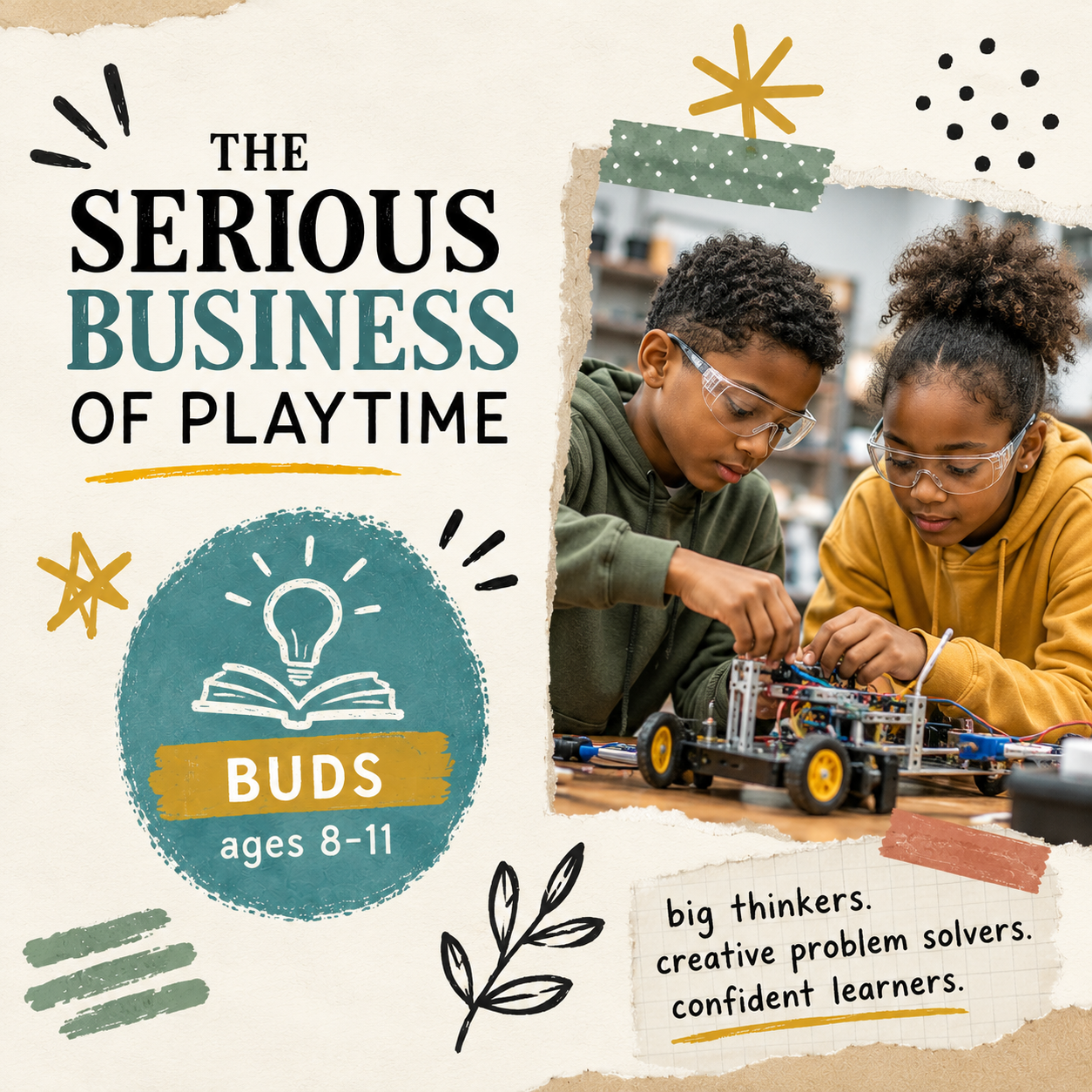
The Serious Business of Playtime: Buds (Ages 8-11)
“The argument over whether that tag counted isn't a discipline problem. It's a Bud practicing due process.”
By the Buds years, play has shifted shape. Pretend gives way to games with real rules — capture the flag, made-up card games with constantly amended house rules, elaborate multiplayer builds in Minecraft with their own economies and laws. These games demand something pretend play didn't: holding several rules in mind at once, adjusting strategy mid-game, and handling the very real disappointment of losing in front of your friends.
This is executive function training in its most motivating form. No worksheet teaches a child to recover from a bad call at second base and keep playing. Complex peer games do that daily, for free, because the child actually wants to be there. It's also why BGA treats Wednesday field trips and unstructured co-op time as core curriculum for this band, not a reward for finishing 'real' work — the negotiation, strategy, and resilience built on the field are the real work.
Under the surface
- Executive function — tracking multiple rules and adjusting strategy mid-game is direct practice for planning and flexible thinking
- Resilience under peer pressure — losing a game in front of friends and choosing to keep playing builds real emotional regulation
- Applied fairness — negotiating whether a rule was broken is early logic and argumentation, done with real stakes
- Collaborative strategy — team games require reading teammates and adapting a plan on the fly
Let a game with disputed rules play out this week without stepping in as referee. Ask the group how they want to resolve it. Notice the reasoning they use — it's more sophisticated than it sounds from the next room.
When a Bud comes inside furious about a disputed call and works it out anyway before the next inning, that's not a break from learning. That's the lesson landing.